
Travelogue Renate Blank November 2025
1. Itinerary
Again and again I find the journey to our project quite exhausting. This time, however, all flights were on time.
It started on November 17, 2025, at 2:10 p.m. from Munich Airport to Cairo. Arrival there 18:50. With the connecting flight in Cairo at 9:50 p.m., I reached Entebbe (Uganda) at 5:55 a.m. the next day.
As always, I was welcomed there by our driver, Mr. Abdul Mutebi and our manager Mrs. Betty Nakajigo. For the first time, the trip to Nkoni took place in daylight and I was able to enjoy the beauty of the landscape and the lively hustle and bustle along the road. However, we were on the road for another six hours, as a truck that overturned in front of us consumed a lot of our time.
With light clouds and about 20 – 25°, the weather was kind to me. Although November is the rainy season, this only means a few (very) heavy showers every day, which are quickly over.
2. Activities on site
I had prepared a long agenda of what I wanted to discuss, do and explore. Most of the time, however, some things turn out a little differently.
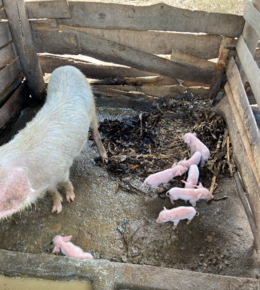
First of all, I was able to convince myself of the professional repair of the wall. Then we went to the pigsty, where today - practically as my welcome gift - a pig had given birth to seven piglets.
The fantastic state of the agriculture was pleasing. All trees and plants are in full splendor and provide a large harvest. Bananas, casava, cassava, beans, sweet potatoes and much more are cultivated in a nature-friendly and ecological way. There is a huge cold frame for growing coffee plants, which are used for personal use but mainly for sale.
3. School, training and career
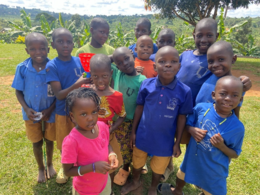
A special concern of mine was to take a look at the developments of the children. That's why I asked to meet as many people as possible on site and talk to them personally.
13 small children from grades 1-2 attend the day school from 7:00 a.m. to 4:30 p.m. They commute daily by school bus. The big challenge is that the school fees are only covered by sponsorships for five children.
Eight children have no sponsorship, and the financing must be taken over by the Association. All of them are orphans or come from completely destitute families. They enjoy living permanently in the hand-in-hand home and are cared for there. It was a great pleasure for us to create letters together for the sponsors which we will forward - together with current photos and certificates - in a timely manner.
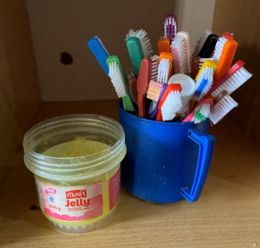
In the course of the next few hours, more and more older children and young people arrived. They attend different boarding schools, which gradually begin with the Christmas holidays. I was not able to meet those who are in exams because they have completed primary or secondary school.
I had a lot of intensive conversations, in which I had to learn above all:
Because so many needy children have to be cared for, at the moment only the costs of school fees and basic equipment (such as notebooks, pens or erasers) can be covered. Each child also receives a tiny pocket money of about 5 euros per term (three months, 3x a year).
The children explain that their diet at school consists exclusively of corn porridge and beans 2 x a day. They use their pocket money for additional small things that they can buy in the kiosk.
Every school year there is a class trip in the higher classes. None of our children has been able to take part in such a course so far (costs approx. 20 euros/child), nor in project work, e.g. in chemistry or physics, for which additional notebooks and books are required (costs approx. 15 euros/child).
It would be nice if we could make this possible with your help.
After graduating from school, the children begin an apprenticeship, currently in the electrics, sanitation, accounting, or kindergarten sectors. I was completely surprised that they don't receive a salary, on the contrary, there are high costs for an apprenticeship.
After completing the training – usually after two years – a job must be found. There are very few larger companies where you can get a contract. Usually you are "employed" by small sole proprietorships. Payment is not made regularly, but exclusively according to the order situation.
The earnings are determined by the client and are usually extremely small, often only 5-10 euros. That is why young people with completed training also live mainly in the HiH Home. They have great fears for the future.
Once again, I became aware that real independence for young people is very difficult to achieve and associated with high costs, not much is really gained by graduating from school.
Best regards and a nice pre-Christmas season
Renate and team
Donation account:
Hand in Hand für Uganda e. V.
Volksbank Raiffeisenbank Dachau
IBAN: DE79 7009 1500 0001 5290 72
BIC: GENODEF1DCA
